What is a signal in the context of FW.io?
A place where people worldwide are documenting the signals shaping everyday life.
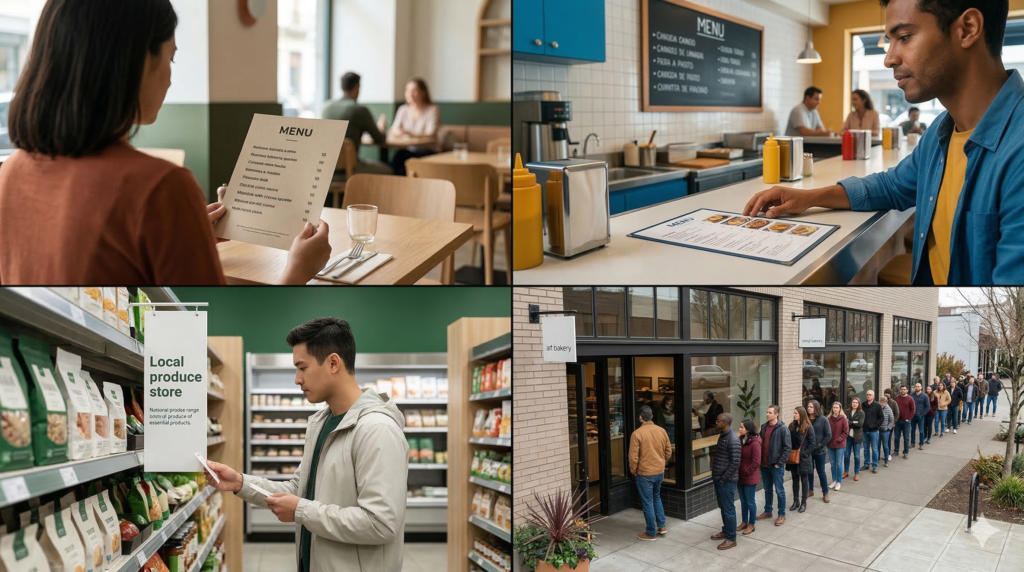
Signals (Shifts) Are Everywhere (If You Know What to Look For)
You might not realize it, but you’ve probably already seen a signal today.
Maybe it was a restaurant that quietly cut its menu in half.
Maybe it was a grocery store shelf where store-brand products suddenly outnumbered the familiar national brands.
Maybe it was a café filled with laptops where people used to sit and talk.
Or maybe it was something even smaller — a clothing style changing, a product disappearing, a line forming somewhere it never used to exist.
Most people see these moments and move on. But sometimes these small observations are clues.
We think of them as signals – early hints that something deeper is shifting underneath our everyday lives.
Signals don’t usually appear first in headlines or reports. They show up in the places people live and work: neighborhoods, stores, workplaces, restaurants, streets. A signal – what we categorize as a shift – is simply a small change in how people behave, what they choose, or how something operates compared to how it used to work.
The challenge is simply noticing them.
Once you start looking for these signals and shifts, the world begins to look different and you start to realize something surprising: they’re everywhere.
Small changes start to connect. Local observations begin to resemble patterns. And patterns sometimes reveal how larger systems are evolving.
That’s the idea behind FW.io.
What a Signal Really Is
A signal doesn’t have to be dramatic. Often it looks like something small at first.
Maybe a local restaurant that used to offer thirty menu items suddenly cuts it down to twelve.
Maybe the grocery store near your house starts dedicating more shelf space to store-brand products.
Maybe a coffee shop that once had a quiet atmosphere is now filled with laptops and remote workers.
Or maybe you notice that people in your city have started wearing older, thrifted clothing instead of new fashion.
None of these things, by themselves, seem like major news stories. But they are clues and they could suggest that something deeper may be shifting underneath everyday life.
Maybe businesses are simplifying operations because costs are rising. Maybe consumers are becoming more price sensitive. Maybe work culture is changing. Maybe people are redefining what status or authenticity looks like.
Signals are simply the surface evidence of deeper changes happening inside systems.
Why Local Observations Matter
One of the most powerful aspects of signals is that they often appear locally before they become widely recognized trends.
Someone in Buenos Aires might notice restaurants simplifying menus months before that pattern shows up in London.
A clothing shift spotted in Tokyo might quietly spread to Berlin and New York later.
Signals tend to emerge in small places first:
- neighborhoods
- cities
- individual businesses
- local communities
That’s why observation matters.
When thousands of people around the world are paying attention to small shifts in their everyday environments, a much larger picture begins to emerge.
What seems like a small local change might actually be part of a global pattern forming across cultures and markets.
Turning a Signal Into a Story
One of the goals of FW.io is to make it easy for anyone to turn a real-world observation into a narrative, and add it to our growing signal base.
You don’t need to be an economist.
You don’t need to work in technology.
You don’t need specialized credentials.
You simply need to notice something changing.
For example:
You might observe that a restaurant near you recently reduced its menu from 25 items to 10.
That’s a signal.
You might begin asking simple questions:
- What changed?
- Why might the business be doing this?
- Is this happening elsewhere?
- What might it suggest about the economy or consumer behavior?
Those questions become the beginning of your narrative.
On FW.io, contributors will be able to submit observations like this through a simple system designed to help shape those same observations into a story, and then see how they connect to other stories from all over the world.
Writers describe the shift they noticed, select the type of change it might represent, and explain what they believe could be driving it.
From there, your story + our framework—and AI assistance built into the platform—can help you expand your observation into a narrative.
The goal isn’t to replace human insight.
The goal is to help you express what they are seeing more clearly.
Introducing the Signal Hunters
Contributors who regularly spot and share meaningful shifts become something we like to call Signal Hunters. A Signal Hunter isn’t someone with a special degree.
It’s someone who pays attention.
Someone who notices the small clues about how the world is changing and brings their narrative to the site. The disappearance of cashiers. The return of film cameras. The rise of local craft goods. The growing number of laptops in cafés.
These observations help build a collective understanding of how the systems that are shaping our everyday lives evolve over time.
Signal Hunters are essentially field observers of everyday life that share what they’re experiencing. And as more people contribute, something interesting happens.
Building a Map of the Real World
FW.io is not just a blog.
Over time, it becomes a map of signals from around the world.
Each narrative submitted by a contributor is tied to a location. A city. A country. A place where someone noticed something changing.
As more signals are collected, they begin to populate a global map of observation. Patterns emerge. Similar shifts appear across continents. Local observations start connecting with other observations thousands of miles away.
Someone in Spain might write about menu simplification.
Someone in Brazil might notice the same thing in a completely different restaurant culture.
Someone in Canada might observe a similar shift happening in grocery stores.
Suddenly your signal isn’t just local. It’s part of a much larger story.
Why This Matters
Understanding how the world is changing is difficult relying only on headlines or traditional news and often manipulated news outlets. Most news focuses on dramatic events-after all, who is going to look away from a “trainwreck”?
Signals are different.
They capture the early stages of cultural shifts and change – part of an interconnectedness. The quiet moments when systems begin adjusting.
By collecting signals from people living inside those systems, FW.io aims to build something different from traditional media.
Instead of broadcasting top-down narratives, the platform grows from thousands of small observations happening in real places.
Each signal is a piece of a larger puzzle.
The Opportunity to Contribute
FW.io exists for a simple reason: no single person can see the whole world changing.
Every day, small shifts are happening in thousands of cities at the same time.
A restaurant simplifies its menu in Lisbon.
A clothing style changes in Seoul.
A grocery store expands private-label products in Toronto.
A café quietly turns into a workspace in Buenos Aires.
Individually, these moments seem small, but together, they form a picture of how the world is evolving.
That’s where you come in.
FW.io is built around the idea that observation belongs to everyone. You don’t need a special title to notice change. You don’t need to work in research or journalism. You simply need to pay attention to the world around you.
If you’ve ever noticed something shifting in your city – a business changing how it operates, people behaving differently, a product appearing everywhere all of a sudden – you are already seeing signals.
And those signals matter.
Because somewhere else in the world, someone might be seeing the same shift.
When you share what you’re seeing, your observation becomes part of something much larger: a global record of how systems, culture, and everyday life are changing.
Contributors to FW.io become what we call Signal Hunters – people who are curious enough to notice the small clues that reveal bigger patterns, then bring their stories to FW.io.
Each signal adds a new point to a growing world map of observation. Over time, those points begin to connect. A shift spotted in one city appears in another. A local story becomes a global pattern.
But none of that happens without contributors.
The platform only works if people like you decide to share what you’re seeing.
Submitting a signal is simple. Describe the shift you noticed. Choose the mechanism that best describes the change. Explain what you think might be causing it. Our framework – and built-in AI tools – can help you shape that observation into a narrative others can read and understand.
Your story might come from a neighborhood restaurant, a workplace, a store, a street corner, or a conversation with someone in your community.
Wherever it comes from, it adds to a much larger map of reality.
And if your story resonates with readers, it may reach people far beyond your city. In the future, contributors will also have the opportunity to participate in revenue sharing based on readership and engagement.
But the real value is something else.
You become part of a network of observers documenting how the world is changing in real time – one signal at a time.
FW.io can’t build that map alone.
We need people everywhere who are willing to notice something small and ask a simple question:
Is this just a random change… or is it a signal?
If you see one, tell your story.
How to Submit a Signal
Submitting a signal is easier than you might think.
Start with something simple you’ve noticed changing around you.
Ask yourself three questions:
1. What changed?
Describe the shift you observed.
Example: A restaurant that used to have a huge menu now offers only a few dishes.
2. Why might it be happening?
Is the change about cost, technology, culture, convenience, or something else?
3. What might it mean?
Could this small shift be part of a larger pattern?
That’s it.
From there, you can use FreelanceWriter.io’s framework – along with built-in AI tools – to help shape your observation into a narrative others can read, connect to, and explore.
You don’t need to have all the answers.
Signals start with curiosity.
Signals Contributors Have Already Noticed
- Restaurants quietly shrinking their menus
- Grocery stores expanding private-label brands
- Coffee shops turning into remote work hubs
- Vintage clothing becoming fashionable again
- More stores replacing cashiers with self-checkout
These kinds of observations are the starting point for great signal stories.
If you’ve seen something like this — or something completely different — it might be worth sharing.
Your Signal Might Matter More Than You Think
The next time you notice something changing around you, pause for a moment.
A smaller restaurant menu.
A longer line at a handmade bakery.
A sudden surge in vintage clothing.
A café filled with remote workers.
Ask yourself a simple question:
Is this just a random change?
Or is it a signal of something larger happening beneath the surface?
Signals are everywhere.
Sometimes all it takes to see them is paying attention. And if you do notice one, consider sharing it. Because somewhere else in the world, someone might be seeing the same shift.
And together, those signals might tell a much bigger story about how the world is changing.